
Why does Diane Abbott think White-Minority groups can’t Experience Racism? And Why I’ve Stopped Using The Term Anti-Semitism.
Does Power + Prejudice = Racism?

Irish, Jewish and Traveller people [...] undoubtedly experience prejudice. This is similar to racism and the two words are often used as if they are interchangeable.
It is true that many types of white people with points of difference, such as redheads, can experience this prejudice. But they are not all their lives subject to racism. In pre-civil right America, Irish people, Jewish people and Travellers were not required to sit at the back of the bus. In apartheid South Africa, these groups were allowed to vote. And at the height of slavery, there were no white-seeming people manacled on the slave ships.
Diane Abbott, letter to The Observer (23rd April, 2023)
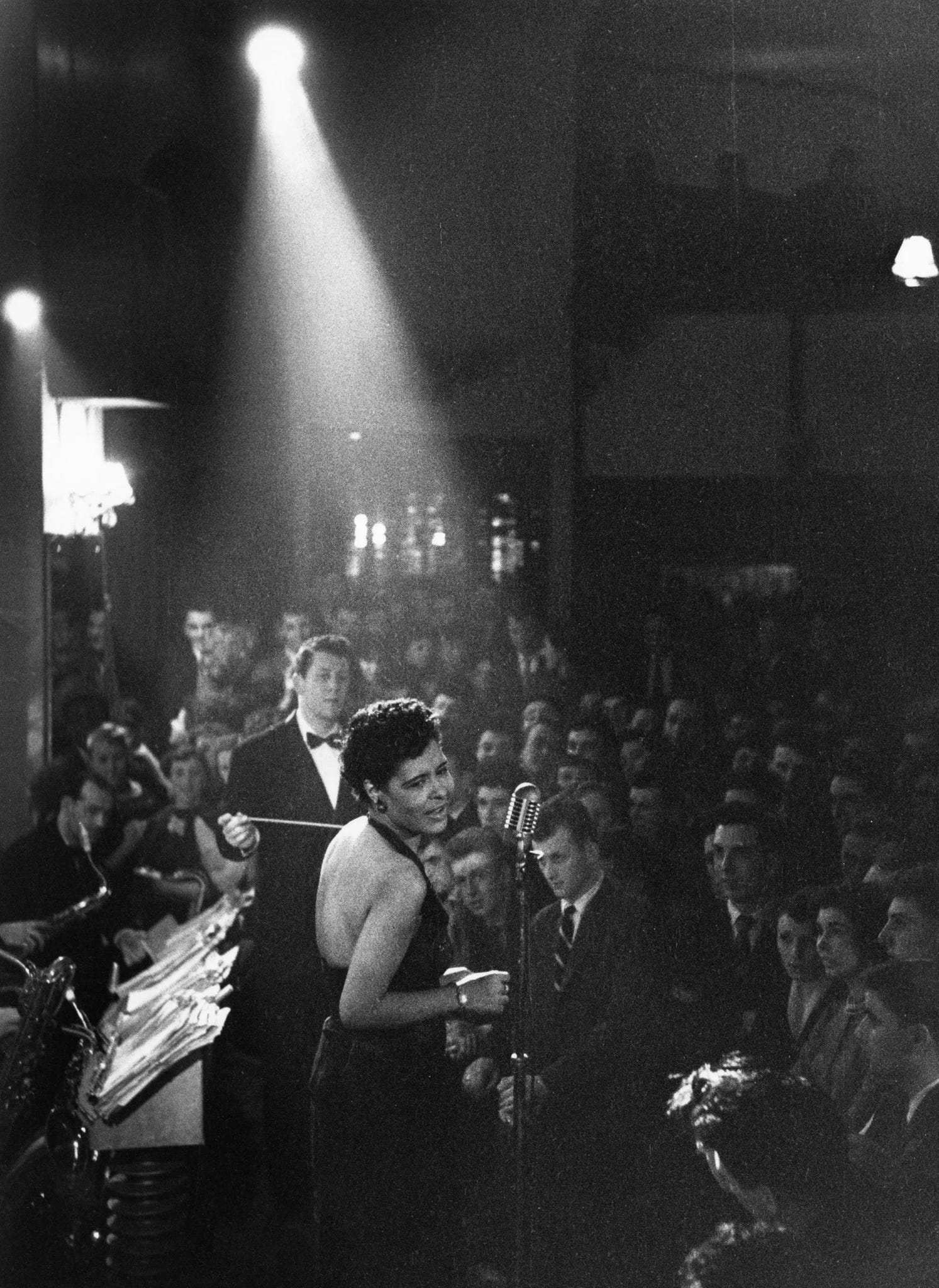
(Billie Holiday; source: The New Yorker)
It’s 1939. A group of drinkers and music lovers are sitting in the Cafe Society in New York. They have come to hear the iconic voice of Billie Holiday. But this night is different from other nights.
In the build up to the show’s finale, the bar stops serving drinks early and all the lights are turned off apart from the one fixed on Holiday. Barney Josephson, owner of the Cafe Society, is worried that a riot is about to start. Josephson is scared that glasses will become projectiles launched at Holiday and others, and lighting might increase the potential for violence.
Then, for the first time in public, these immortal words passed Holiday’s lips,
Southern trees bear a strange fruit
Blood on the leaves and blood at the root
Black bodies swinging in the southern breeze
Strange fruit hanging from the poplar trees
(Watch Holiday here)
Holiday was singing about lynchings, which were a regular fixture in the South of America. For the rest of her career, Holiday ended almost every show with this song and suffered professional damage as a result.
Holiday’s version of strange fruit might not be your favourite. Personally, Nina Simone’s rendition puts goosebumps on my arms each time I hear it. The song is an international civil rights anthem and remains a rallying cry for those opposed to racism today. Kanye West even put his own spin on this classic, sampling it in his song Blood on the Leaves.
But the song was very nearly forgotten. Columbia, Holiday’s record label, refused to record Strange Fruit for fear of backlash in the South. Eventually Milt Gabler, owner of an independent record label and the son of Jewish immigrants from Austria, agreed to record it.
Finding a place to sing Strange Fruit was also unlikely. Cafe Society was perhaps the only place in America where it could be heard. This was one of a tiny number of venues where black and white customers would sit alongside each other. Barney Josephson, owner of the Cafe Society and the son of Jewish immigrants from Latvia, believed it had to be heard by his patrons.
Strange Fruit was not actually the original title of the song. Lewis Allen, the poet and teacher who wrote the lyrics, originally entitled it Bitter Fruit. Allen, like the song he wrote, is lesser known by his original name, Abel Meeropol. Meeropol’s parents were Jewish immigrants who fled Russian pogroms in 1903.
Allen grew up listening to stories of race based massacres suffered by his family. He understood that there were only facial differences between the racism experienced by Jews and African Americans, he made this explicit in another poem, “I am a Jew,/ How can I tell?/ The Negro lynched/ Reminds me well/ I am a Jew.”
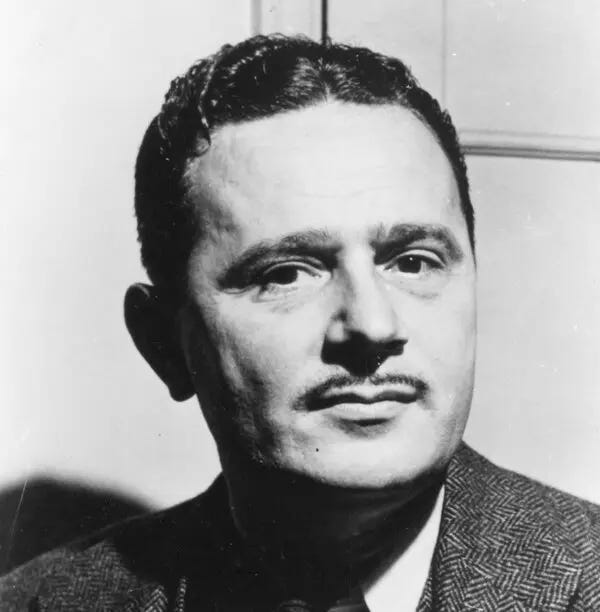
(Abel Meeropol, A.K.A. Lewis Allen; Source: The New York Times)
What does this have to do with Labour MP Diane Abbott’s recent letter to The Observer? Responding to an article by Tomiwa Owolade about the complexities of racism, Abbott wrote, “Irish, Jewish and Traveller people” can’t experience racism. Instead, they can only suffer “prejudice”. The experience of these white-minority groups is no different to “redheads” who also have a hard time. [For full letter, see the top of this article.]
Abbott is clearly wrong. Suggesting that historical and contemporary racism towards Jews, Irish, and Travellers is no different to bullying ginger kids is both an odd hill to die on and, frankly, offensive.
But simply saying that Abbott is wrong isn’t productive. Abbott’s views are a symptom of a progressive movement which is redefining racism, and many people share her ideology. People like Abbott don’t take seriously the racism experienced by white-minority groups, while claiming to be “against all forms of racism” themselves. The way they are able to do this is by rejecting the notion that anyone with white skin can experience racism.
Josephson, Gabler, and Meeropol knew that explaining the oppression of others enabled their own fears and experiences to be empathised with. They understood that racism against any minority group is a threat to all minority groups. But this view is losing favour on the left.
Where does the prejudice argument come from?
It makes sense that Abbott references America when explaining her beliefs about who can and cannot suffer racism;
In pre-civil right America, Irish people, Jewish people and Travellers were not required to sit at the back of the bus.
Abbott’s beliefs, which she has since disavowed, are common in progressive American institutions, where racism is often taught as an experience reserved solely for non-white people.
The argument goes that anyone can suffer prejudicial treatment, however, racism can only be experienced by those who have been systemically disempowered. An equation, made in 1970, explains how racism manifests:
Power + Prejudice = Racism
The reason why power is apparently crucial to this definition is due to transatlantic slavery, its causes and its legacy.
Due to slavery, throughout much of American history white people had access to social and political power while black people did not. Even though civil rights progress has been made post-abolition in 1865, African Americans remain systematically oppressed in America. This is true in relation to the criminal justice system, healthcare outcomes, home-ownership, and government investment in communities.
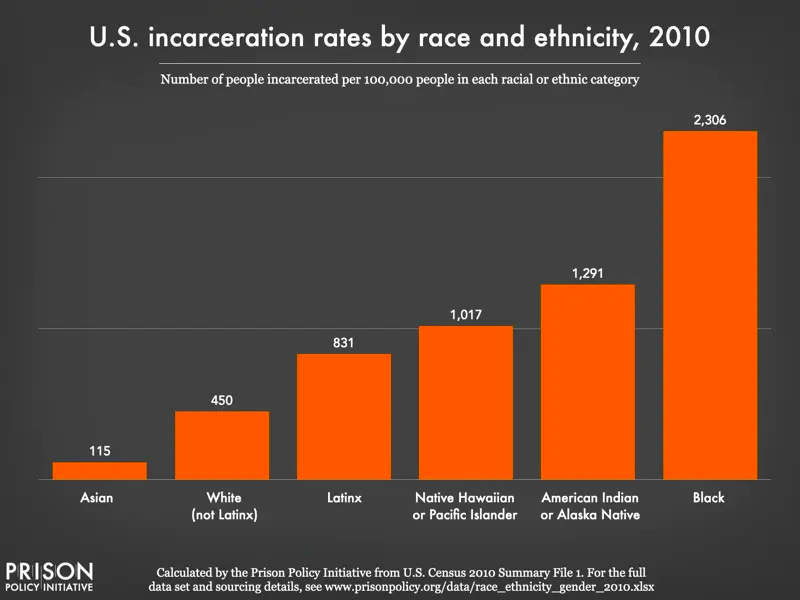
Post-abolition, the South of America was governed under Jim Crow Laws, which defined blackness as having a single-drop of ‘black blood’. For much of white American society, in the North as well as the South, any black characteristics, regardless of how insignificant they were, were seen as immutable and undesirable. Black people were legally and illegally prohibited from integrating with white communities, causing intergenerational marginalisation and poverty.
Over time, the systems that lay the foundations of society had anti-black and pro-white racism baked into them. This means that everything in society is designed to disadvantage people of colour. Accordingly, racism does not need to be explicitly, or even implicitly, expressed for it to remain a constant feature in every interaction. This is the essence of critical race theory (CRT).
As a result of this, a power continuum based on skin colour underpins everything in society. The shorthand explanation for this is the lighter a person’s skin, the more power and privilege they carry; the darker a person’s skin, the less power and privilege they carry.
In America, people with white skin or light skin have the luxury, or privilege, of being visible when they are suffering and disappearing when they should be scrutinised. The inverse is true for people with dark skin, and the darker someone’s skin the more acute this becomes.
American academics argue that due to colonialism, this power continuum has spread around the world like a virus. The skin-whitening market in India and East Asia is often pointed to as an example of this. So too is the fact that darker skin is often seen as undesirable in much of Latin America and North Africa. White and light skin privilege is a global phenomenon, and thus white people can never truly understand what it means to be powerless.
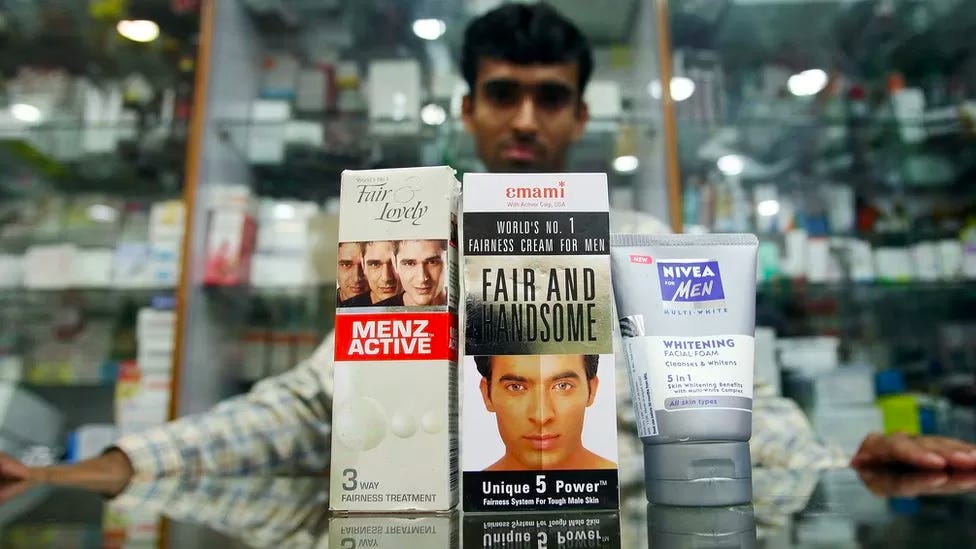
(Source: BBC)
Progressives often point to the different treatment given to Ukrainian and Syrian refugees as evidence of this. Ukrainians have been welcomed with open arms across Europe and the plight of their people is constantly focused upon. Syrian refugees, on the other hand, were portrayed as a burden on Europe, and in some outlets presented as a threat. The conditions of their refugee camps received relatively little attention, too. Progressives explain this through the lens of skin colour.
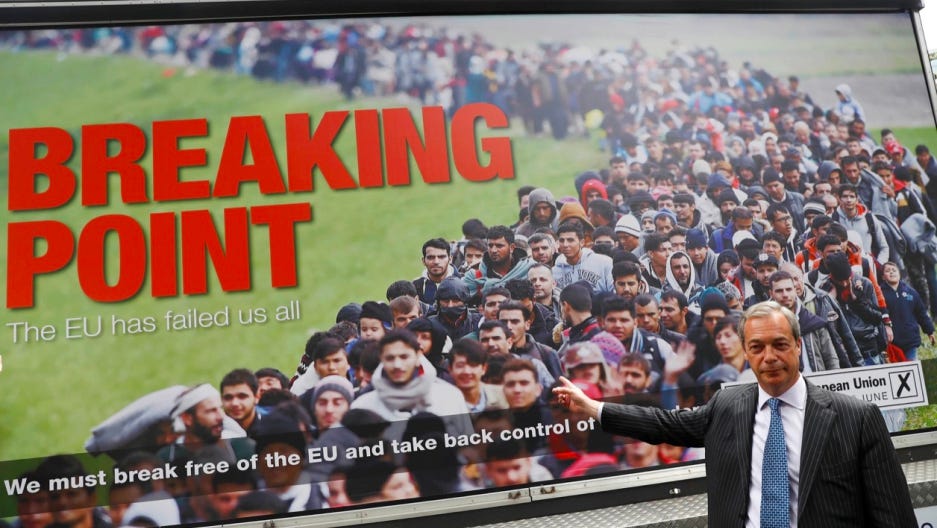
(Nigel Farage during the build-up to the Brexit vote standing in front of a poster indicating that Syrian refugees will come to Britain unless the UK votes to leave the EU)
Being white allows people access to both the power necessary to oppress other groups and the visibility necessary to be helped. Having access to this power and visibility disqualifies an individual from being able to experience racism.
The power and prejudice argument is divisive and counterproductive
The slaying of a beautiful hypothesis by an ugly fact.
Thomas Henry Huxley
Much of the argument laid out above is undeniable, especially when looking at the landscape of inequality and disadvantage in contemporary America.
I also have sympathy for American academics who want to reserve the term racism for non-white people. For them, the oppression experienced by African Americans is unique. Correspondingly, this should be uplifted and acknowledged with exclusive language. Seemingly, they believe if the term racism is available to people with white skin the word’s meaning will be trivialised.
But the world does not exist in a black-white binary. And while CRT is a useful analytical framework to see the world through, any theory used to explain the whole world is bound to fall short when confronted with the complications of real life.
Meeropol, Josephson, and Gabler all understood the importance of the song Strange Fruit. The song needed to be heard because it explained an experience they could empathise with, an experience they feared.
Pogroms and persecution caused hundreds of thousands of Jews to flee Europe. Many of these refugees came to America and saw obvious similarities between the way African Americans were treated and the racism they had tried to escape from.
Pogroms were commonplace in the South of America, and African Americans were the main targets. The Equal Justice Initiative (EJI), estimates there were 4,084 lynchings in twelve Southern states between 1877 and 1950.
One of the most infamous examples is the Black Wall Street Massacre in Tulsa, 1921. During this incident, at least thirty-six black people were killed and thousands were injured. This event is the backdrop for the recent HBO series Watchmen, and it is well-remembered not only because of its brutality, but also because it is an example of white supremacists refusing to allow African Americans to establish a wealthy, thriving community.
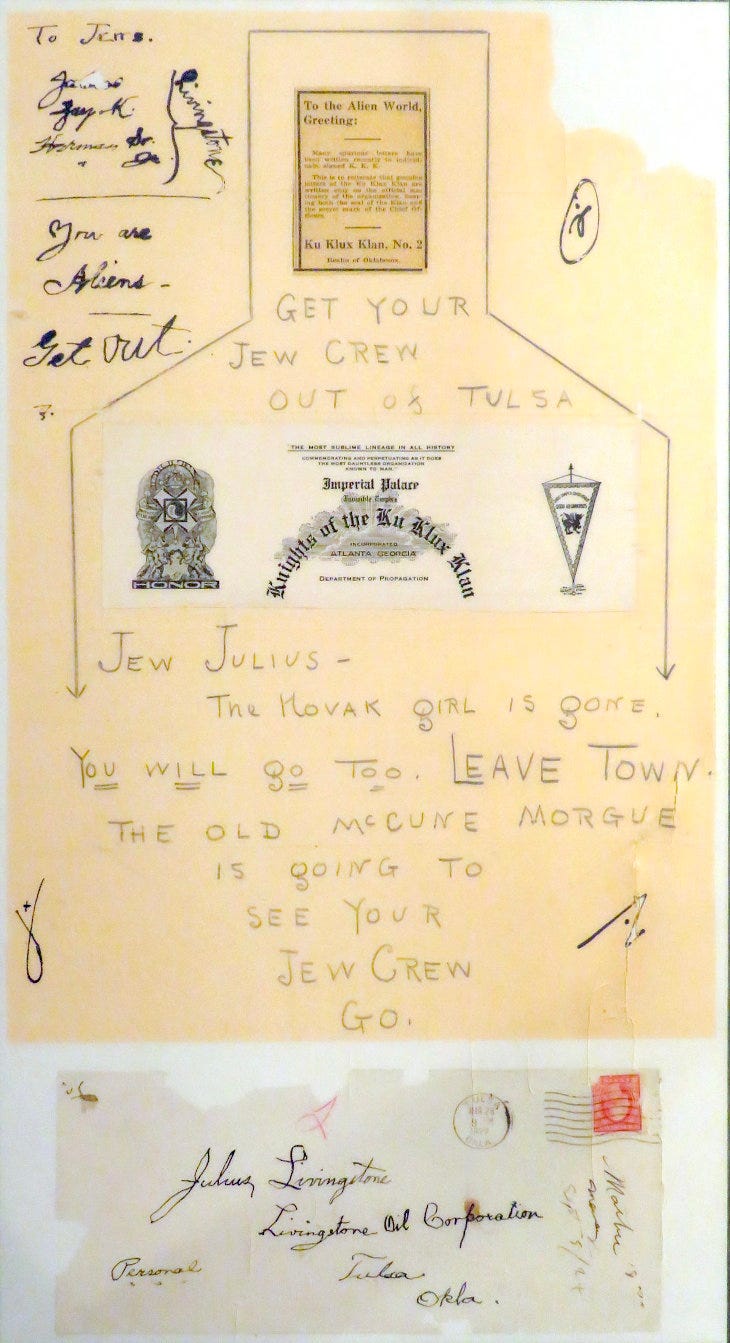
Less well-known is that the Ku Klux Klan were also intent upon harassing Jews. During the massacre, Jewish store owners hid black Oklahomans and were also targeted by white supremacists.
(Source: Aish)
This is a letter sent to Julius Livinstone, a native of Tulsa, by the KKK in 1922. During the massacre, Julius' parents, Nathan and Anna, hid ten black families in their house for several days until it was safe to leave.
More than forty years later, the KKK would kill Andrew Goodman and Michael Schwerner, both Jews, and James Chaney, an African American, during the Mississippi Burning murders in 1964. They had all travelled to the Deep South to protest as freedom riders.
Jews also feared for their safety in the North of America. In February 1939, in the same year and city Holiday first sang Strange Fruit, 20,000 American Nazi supporters rallied in New York’s Madison Square Garden to show their support for Adolf Hitler.
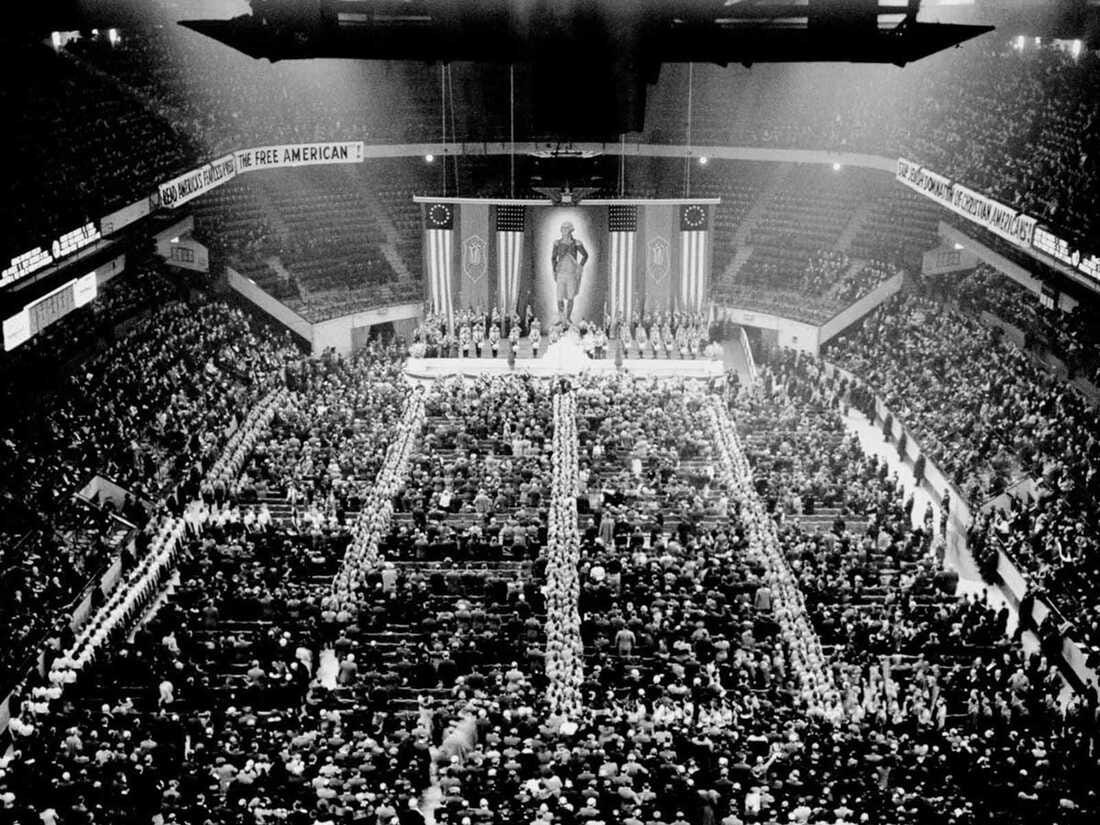
(Madison Square Garden; source: NPR)
More recently, in 2017 during the Unite the Right rally in Charlottesville, hundreds of white supremacists came to protest the removal of confederate and slave-owner General Robert E. Lee’s statue. As these racists marched through the city’s biggest university, the University of Virginia (UVA), they chanted and held signs saying “Jews will not replace us!”
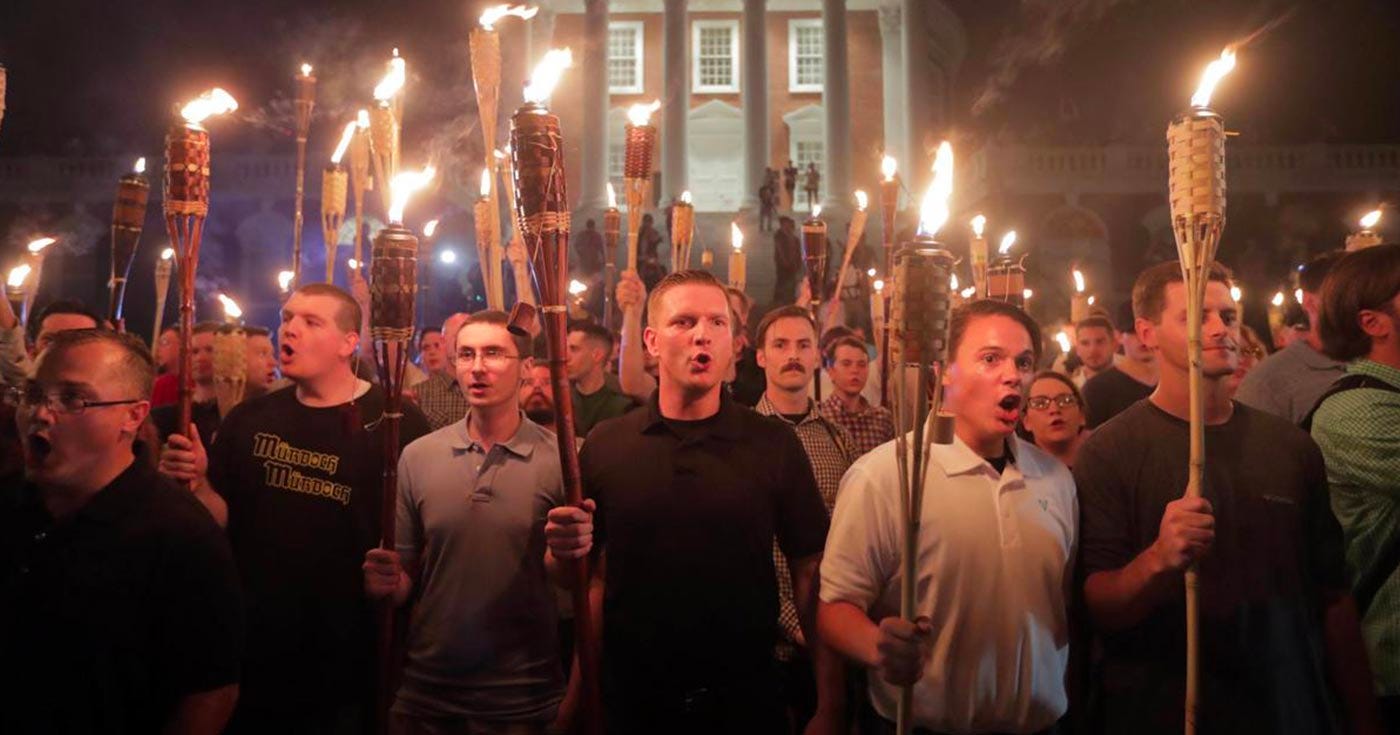
(White supremacists in front of UVA’s Rotunda; source: Equal Justice Initiative)
It is self-evidently divisive to state that two people are incapable of experiencing the same phenomenon. However, It is Orwellian to explain identical experiences with different language, especially when this language is coded to indicate that one experience is more severe or important than another. This immediately diminishes the experiences of one group in comparison to another.
Racism towards white minority groups is not a thing of the past and it looks similar, and sometimes identical, to racism against non-white groups.
In 2018, the Tree of Life Synagogue became the site of America’s most deadly massacre of Jews. Eleven worshippers were gunned down by a man wielding an assault rifle. The murderer had been planning to target a synagogue, but chose the Tree of Life because it had begun to provide legal assistance to refugees.
It is hard to see why this is an act of prejudice, while the horrors experienced by African American church goers during the Charleston Church Attack, or Muslims during the Christchurch Mosque Shooting in New Zealand, is racism.
To say one is racist and the other prejudice is an example of newspeak (n):
propagandistic language marked by euphemism, circumlocution, and the inversion of customary meanings.
Whatever power the eleven victims of the Tree of Life synagogue inherited, it wasn’t strong enough to keep them safe. Their killer was inspired by hatred and their deaths were made no less brutal because they were spared racism (apparently). Claiming one incident was an act of prejudice, while the other two were acts of racism, suggests it was less important.
And to suggest that these incidents are similarly important, but fundamentally different, is to advocate that anti-white racism and racism are phenomena which are separate but equal.
What begins to emerge is the view that some racial groups are more ‘perfect victims’ than others. Those who have historically suffered the most deserve more sympathy than those who were comparatively better off. This is known facetiously as the Oppression Olympics.
Believing that power is ‘fixed’ is just another stereotype
There are three fundamental flaws underlying Abbott’s reasoning:
All people within an identity group share the same experience
Power is fixed rather than dynamic
An expanded definition of racism diminishes the suffering of people of colour
Abbott claimed that, “many types of white people with points of difference, such as redheads, can experience this prejudice. But they are not all their lives subject to racism.”
This was not true for the 1.5 million Armenians, 6 million Jews, 200,000 Roma and Sinti who were killed during holocausts in the first half of the 20th century.
Moreover, suggesting that all people who look similar must experience similar things is a lazy stereotype. In fact, this is the basis for profiling.
Labour MP, Rupa Huq, had the whip taken away last year for expressing the same wrongheaded beliefs. In a moment of complacent honesty, Huq let slip her view that Kwasi Kwarteng was not really black.
Born Akwasi Addo Alfred Kwarteng in London to two Ghanaian parents, Kwarteng, the first black Chancellor of the Exchequer, was accused of being “superficially black” by Huq. The Labour MP explained, “He went to Eton, he went to a very expensive prep school […] if you hear him on the Today programme, you wouldn’t know he’s black.”
Kwarteng, according to Huq, could not be black, or at least not really black; he didn’t grow up working class and nor does he sound black. Using the same logic, our Prime Minister with his two Indian parents and Indian wife (who doesn’t hold a British passport), couldn’t possibly understand what it’s like to be really Indian; how could he, having gone to Winchester?
Huq falls foul to her own logic, too, having gone to a fee-paying high school in Notting Hill, how could she understand what it means to be really South Asian?
Believing that people cannot be ‘correct’ members of a racial group because of their political views, class, or wealth is simply the racism of low standards. Moreover, it strengthens the racist attitude that stereotypes are correct.
Both Huq and Abbott share the belief that power is fixed rather than dynamic. Indeed, power and privilege can certainly be inherited (the UK literally has a monarchy). But we live in a complicated world where both individuals and groups can experience changes in their fortunes.
People can gain power when once they had little, but this does not mean they lose the ability to experience racism. Abbott was the first black female MP ever elected in the UK. To do this, she had to overcome enormous odds. And in doing so, Abbott became someone with real power. But with increased visibility, Abbott became one of the most abused figures in British political history, and much of the abuse she suffered was racist. Abbott was both powerful and a victim of racism.
The abuse Abbott suffered is similar, if not identical, to the racism experienced by her former Labour MP colleague, Luciana Berger. When Berger was pregnant in 2018-19, she was targeted online by what was called the “Filthy Jew Bitch Campaign”.
So serious was the threat against Berger’s life that - in breaking with customary protection protocols for backbench MPs - she was constantly flanked by a visible police entourage when attending public events. The events she attended were hosted by Labour, and the threat she faced was from supporters of the party she represented.
Division is the enemy of curiosity, imagination, and empathy
Abbott exposes an attitude that requires attention: racism towards Jews, Irish, or Travellers is not taken seriously. This was true before American beliefs about power and privilege filtered into leftwing British politics.
Whilst it might be uncomfortable to admit, white minority groups are partially to blame for this.
In the same way many Americans believe racism is a term that should be reserved for African Americans, due to the severity of the oppression experienced by this group, many Jews believe that anti-Semitism is the most pernicious form of racism. It is so grave that it shouldn’t be articulated simply as racism, it requires its own special category which only Jews can access.
This is a view held by some philo-Semites, too. For instance, John Mann, the anti-Semitism tsar in the UK’s House of Lords believes, “it is the worst of racisms, and [...] anyone who is antisemite should be called [...] a racist.” Whilst it’s always nice to know someone is willing to stick up for your cause, Mann falls into the same trap that Abbott does. Ranking victims is the Oppression Olympics and intrinsically divisive.
When Jews complain of anti-Semitism, many people believe this to be a uniquely Jewish experience. But the truth is it is just racism.
When non-Jews hear the expression anti-Semitism, most of them cannot imagine experiencing it themselves. The specificity of the word prevents people from imagining what it must be like to be on the receiving end of anti-Semitism. And when people can’t imagine what it is like to stand in your shoes, it is difficult for them to empathise with you.
Anti-Semitism has become an alienating term which represents the experiences of a special interest group. Real anti-Semitism - some believe - is a thing of the past, and only periodically does it rear its ugly head. This is because the word is tethered to a historical event, the Holocaust, by Jews and non-Jews alike.
The term anti-Semitism is no longer the best way for Jews to communicate their experience. My suspicion is that a similar thing is true for other white-minority groups, too.
However, racism is a word that people understand and take seriously.
Abel Meeropol knew that communicating through a shared language was essential to make people hear the pain caused by racism. Only when people understand one another can political movements cross boundaries and gain strength.
Luciana Berger resigned because of racist abuse and death threats. The Labour Party did not support her because the leadership refused to take her experience seriously.
Nevertheless, Berger’s experience gave me a window to the world of other MPs who are subject to race-based hatred, like Diane Abbott. Perhaps if Abbott realised Berger’s experience was no different to her own, she would be the one being invited back into the Labour Party.
`My oppression does not enoble me. ` wrote James Baldwin. He recognised the stupidity of the ideas Abbot proposed.